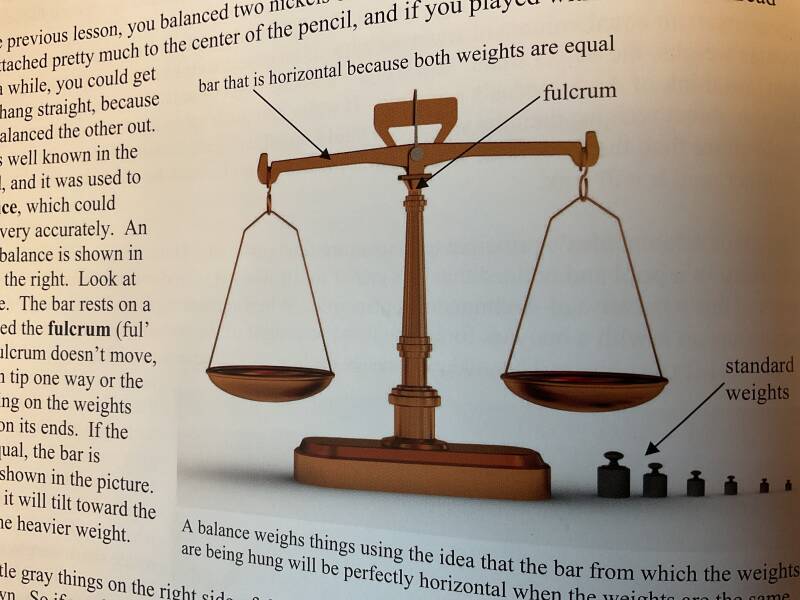
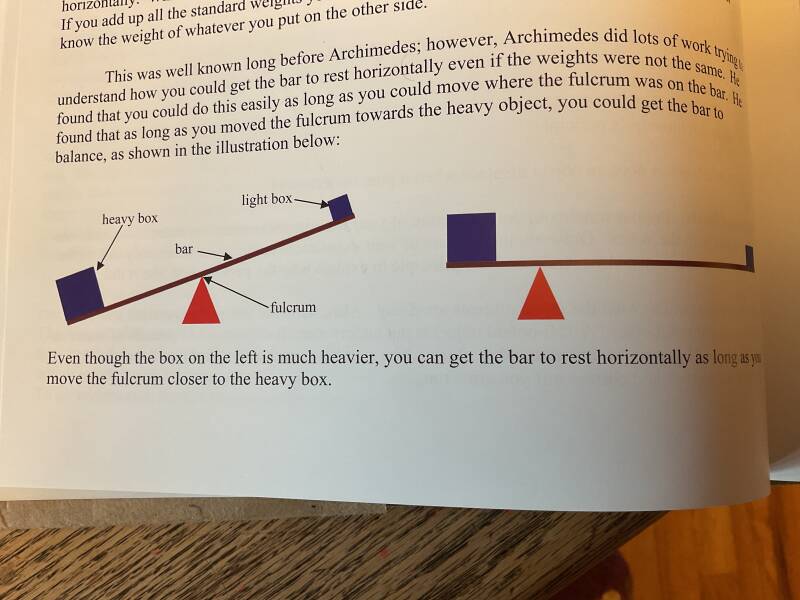
Lesson 25: This lesson is about Archimeds and his discovery of how a lever is used to move heavy objects. His idea came from how a balance works. When you weight something with a balance, there is a fulcrum in the middle which holds up a horizontal bar, and two holders dangle down from this bar. As you add weights to both sides, they tip up and down, showing which side is heavier. Naturally, the side with a heavier object goes down, and the side with a lighter object goes up. However, Archimedes also discovered that if you could move the fulcrum closer to the heavier object, the two sides would eventually balance out. (See picture below). He used this knowledge to discover how using a beam and fulcrum, you could apply a downward pressure to lift a very heavy object if the fulcrum is close to the heavy object.
Lesson 26: Archimedes also did experiments with pulleys and learned how they help us lift heavy objects. A simple pulley is a device with one wheel. You have a rope over the wheel. Attached to one end is the heavy object, and you pull down on the other end to lift it up. A block and tackle pulley is more complex because it involves 3 wheels. It multiplies the amount of energy by 3 to pull the object up 3 times easier! If you kept adding block and tackle pulleys, it would become easier and easier to lift the object.
Lesson 27: Archimedes was trying to figure out truths about circles.If you have a pie and cut it in half, the distance from one end of the pie to the the other side is called the diameter. The name for the distance around the crust of the pie is called the circumference. He saw that if you have a small circle, it will have a small diameter and circumference. And if you have a large circle, it will have a large diameter and circumference. He saw that the circumference of a circle is always about the same as the diameter x3, in fact it is always 3.14x the diameter. He called this number “Pi.”
Add comment
Comments